





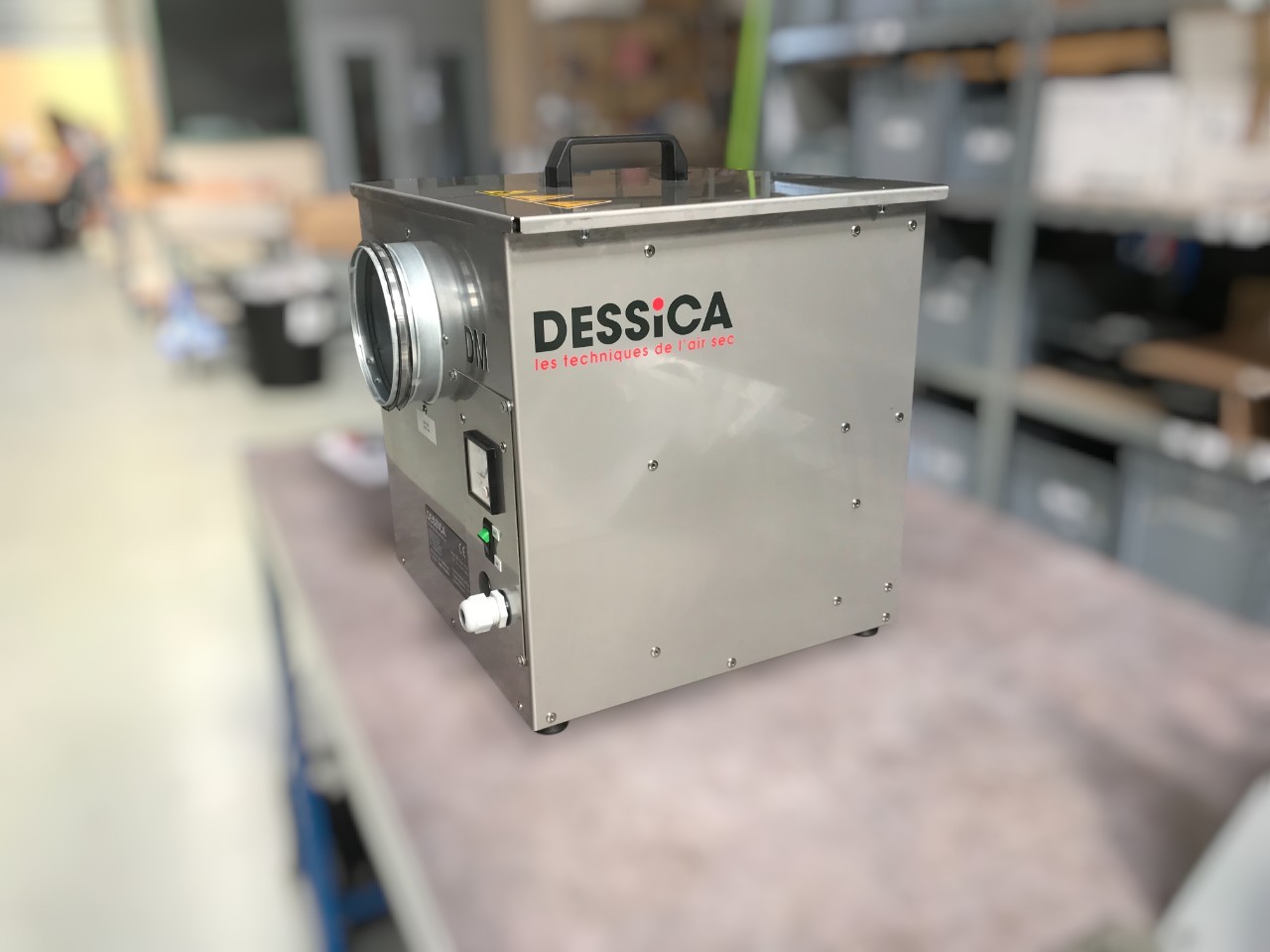
Whether you want to protect your facilities, improve production quality, preserve your products or foster workers comfort, it is important to take several criteria into account: the desired humidity level, the ambient temperature, the volume to be treated and any installation constraints. In this guide, DESSICA helps you identify the most effective and sustainable dehumidification solution for your business.
Why use a professional air dehumidifier?
Using a professional air dehumidifier is essential for controlling humidity in many industrial environments and ensuring product quality, facility safety, and proper functioning of equipment. Excess humidity can lead to corrosion, mould growth, production stoppages, and even the deterioration of sensitive raw materials. Thanks to high-performance systems such as those offered by DESSICA, it is possible to maintain stable humidity levels adapted to the specific requirements of each industrial process (agri-food, pharmaceutical, clean rooms, etc.). Professional dehumidifiers guarantee precise humidity control, optimize storage conditions, increase equipment durability, and enhance the reliability of manufacturing processes. By reducing the risks associated with humidity, they also help improve indoor air quality and workers safety. At DESSICA, our equipment is designed to adapt to your technical and environmental constraints, while guaranteeing energy efficiency, durability, and ease of maintenance.
The different types of professional dehumidifiers
There are two main categories of industrial air dehumidifiers: desiccant wheel dehumidifiers and condensation dehumidifiers (also known as refrigerant dehumidifiers). Their main difference lies in how they operate. Desiccant wheel dehumidifiers, also known as adsorption dehumidifiers, use a technology based on a rotating wheel impregnated with silica gel, a highly effective desiccant for capturing moisture from the air. Conversely, condensation dehumidifiers operate by lowering the temperature of the air in contact with an evaporator coil. This cooling causes the moisture in the air to condense, thus allowing it to be extracted.
Advantages and disadvantages of professional air dehumidifiers
Desiccant wheel dehumidifiers, also known as adsorption dehumidifiers:
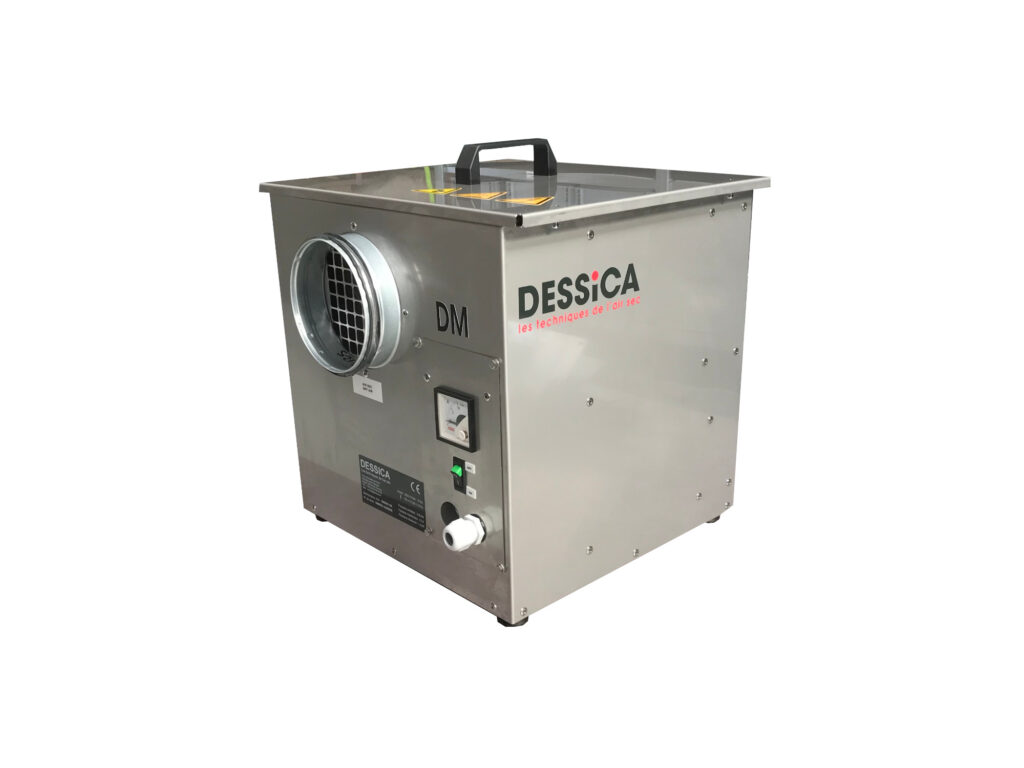
Advantages :
- Adsorption air dryers are used when low humidity (below approximately 30%) at low temperatures is required.
- air dryers are designed to dry air and be installed in environments with a temperature between -15 and 40°C.
- air dryers consume less energy than condensation dehumidifiers when low humidity levels are required.
Disadvantages :
- Temperature rise from +15 to 20°C
Condensation Dehumidifiers, also known as Refrigerant Dehumidifiers:
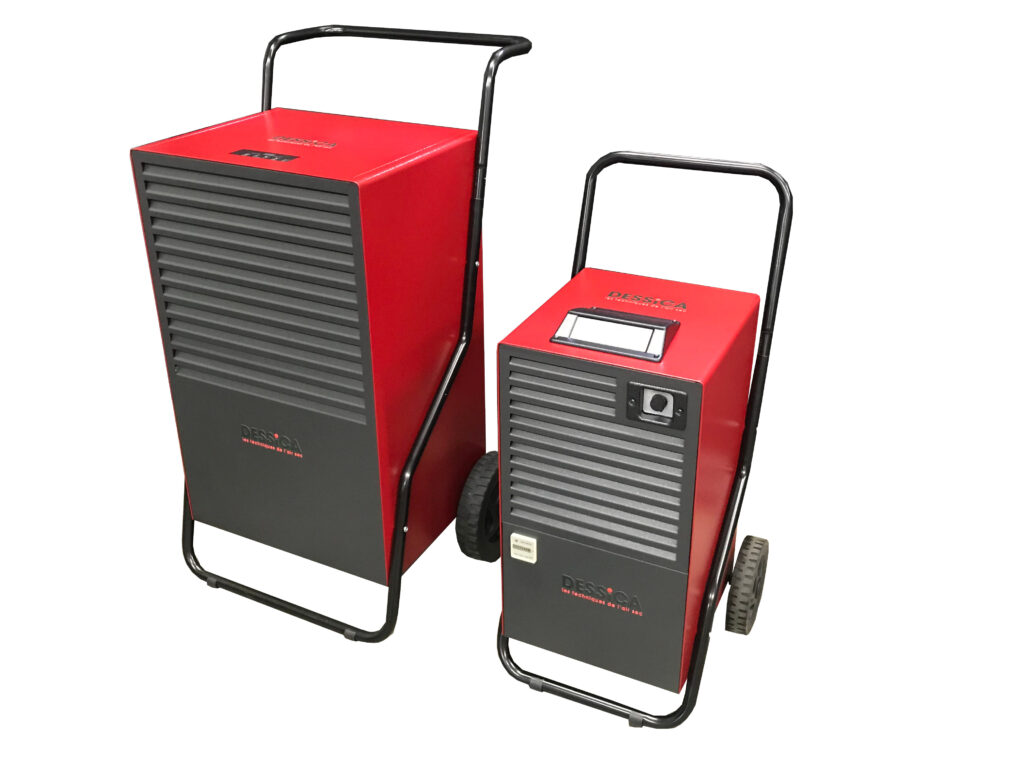
Advantages :
- The temperature increases by only +2°C.
- Condensation air dehumidifiers are less expensive to purchase.
Disadvantages :
- The operating range of condensation dehumidifiers is limited to temperatures between +7°C and +35°C and relative humidity levels between 35% and 95%.
- •Condensation air dehumidifiers lower the temperature below the dew point, which is both costly and requires a significant amount of energy to operate.
To learn more about this topic, read: FAQ – The difference between a dehumidifier and an air dryer
Temporary hire solutions: try out our equipment with no obligation
Do you need a dehumidification solution for a limited period of time or would you like to try out our equipment before making a long-term investment?
DESSICA offers hire solutions for industrial air dryers and dehumidifiers, available for a few weeks or several months. Our equipment is delivered, installed and commissioned by a team of experienced technicians. Bespoke follow-up is provided throughout the rental period to guarantee the performance of the installation. Thanks to our fleet of high-performance industrial equipment, you benefit from the reliability of our equipment and our expertise, with complete flexibility. Ideal for one-off needs, real-world testing or temporary installations for specific projects, hiring allows you to get guaranteed results without the obligation to purchase.
Criteria for choosing a professional dehumidifier
The choice of a professional dehumidifier depends on several technical parameters that must be decided according to your specific needs.
➔ Dehumidification capacity is a key criterion. It is expressed in litres per day or kilograms of water per hour, at a temperature of 20 °C and a relative humidity of 60%. It varies depending on the humidity level you want to reach in the room. At DESSICA, our equipment covers a wide range from 0.6 kg/h to over 54 kg/h, and from 35 to 80 litres/24h for condensation models
➔ The air flow rate, expressed in m³/h, must be adapted to the size of the room to be treated, to the air infiltrations and outlets (door openings and ventilation). Our solutions range from 200 m³/h to over 100,000 m³/h.
➔ Energy consumption, expressed in kW, mainly consumed by the regeneration air heating element, is also important: our dehumidifiers can be powered by electricity, steam, hot water or gas, depending on your available sources of energy.
➔ The noise level is expressed in dB(A). The average noise level of industrial air dehumidifiers is 63 dB(A), which is equivalent to the noise inside a moving car.
Dessica dehumidifiers are industrial machines and are not designed for installation in homes or residential buildings.
➔ Ease of use and maintenance: our equipment is designed for industrial use, with simplified maintenance. We recommend the following operations: regular filter replacement, yearly visit by a technician, desiccant wheel replacement every 8 to 12 years (depending on use). Dessica provides its customers with a responsive maintenance and after-sales service (find out more).
➔ Manufacturing site: Dessica is the only French manufacturer specialising in dehumidifiers and air dryers. Our premises and production workshop are located in France the Rhône-Alpes region, north of Lyon.
➔ Company expertise: Dessica has been an expert in the field of industrial air dehumidification since 1999. The team is made up of technicians and engineers who specialise in dry air technology. DESSICA offers its customers a comprehensive approach: research and design, manufacturing, commissioning, maintenance, hire and temporary installations.
With over 25 years of expertise, our team of engineers supports you from the initial project study phase through to commissioning.
Read the article: How industrial air dehumidifiers work
Options and features of professional dehumidifiers
In addition to the basic configurations and depending on the model, several options and features are available:
- Potentiometer for adjusting air flow
- Remote start system
- Pre-filtration and final filtration
- Hour meter
- PLC with start and stop sequence, machine safety and fault reporting
- Configurable left or right dry air direction
- Wheeled body with lifting eyebolt
The following options and features are available on the most advanced models:
- Operating feedback
- Various sensors
- Desiccant wheel rotation control
- Operating time
- Dehumidifier filter clogging control
- TCP/IP communication over an Ethernet port: transfers information from a computer to another device.
Accessories for professional dehumidifiers, depending on the model:
- External filter boxes
- Wall mounting bracket
- Hygrometric probe for measuring relative or absolute humidity
- Hygrostat: device used to maintain a constant level of humidity in a specific area
The various industrial applications of professional dehumidifiers:
Professional air dehumidifiers are useful in many sectors where humidity control is essential to process quality or product preservation. In the agri-food industry, they help preserve the quality of raw materials, prevent mould and maintain strict hygiene conditions. The pharmaceutical sector uses them to guarantee the stability of moisture-sensitive products and ensure the compliance with regulations of production environments. In the construction industry, this equipment is used to accelerate the drying of materials and prevent moisture-related damage. For storage and logistics operations, they protect sensitive goods from corrosion, prevent frost formation and ensure optimal dry air storage. Whatever the application, dehumidifiers enable effective humidity control, extend the equipment life and improve working conditions. At DESSICA, we offer solutions adapted to every need, drawing on our recognised expertise and extensive range of equipment.
To find out more about this topic, please visit: FAQ – How to choose an industrial air dehumidifier?


