





Customer’s business sector
Based in Vénissieux (France), Advantelec is an industrial SMB specialising in the distribution of electronic and electrical components, particularly lithium batteries. The company outsourced the manufacturing of its products to China until 2025, focusing on design and distribution. With the ambition of relocating its production in France, thus gaining greater technological control, it embarked on a strategic project: fully integrating its value chain through the establishment of a mega-factory dedicated to the design and manufacture of lithium battery cells. Once combined with a BMS (Battery Management System), these cells become batteries used in drones, ground robots, underwater drones, etc.
This change in business model required an investment of €8 million (Source: mesinfos.fr) in a state-of-the-art production facility, including approximately 650 m² of ISO 7 and ISO 8 clean rooms.
Context and industrial challenges
When setting up its first battery cell manufacturing plant in France, Advantelec faced a major challenge: creating a controlled production environment from scratch. The manufacture of lithium battery cells requires strict hygiene and humidity conditions, with extremely dry, filtered air, especially to prevent contamination of sensitive components.
Humidity in the air can indeed generate microdroplets, which can deposit pollutants on materials and alter the quality or even the performance of the produced cells. And lithium triggers an almost uncontrollable exothermic chain reaction that can ignite its surroundings.
To meet these requirements, the company invested in approximately 650 m² of ISO 7 and ISO 8 classified clean rooms, divided into different climate-controlled zones:
- A zone at –50°C dew point with a supply air dew point below –60°C
- A zone at –10°C dew point
These specifications were defined after more than one year of preparatory work, during which the teams analysed the standards and practices observed in Chinese gigafactories and adapted them to the French industrial context. The technical specification was fully custom-designed, considering the site’s technical, energy-related, and operational constraints.
Humidity and temperature are closely linked. The lower the temperature, the drier the air can be, which is precisely what is required in this context. While reducing the temperature helps achieve drier air, it must not affect the thermal comfort of operators. A compromise was established around 23–25 °C to balance technical performance with workplace comfort. A maximum number of operators per room was also defined to limit moisture emissions. A strict protocol for managing flows, access, and behaviour within the clean room (door openings and time spent inside) complements this setup. This concession ensures a stable environment without overloading the electrical network, while considering the site’s geographic location and available electrical capacity.
Nowadays, Advantelec operates a pilot production line with a capacity of 20 MWh and aims for a gradual scale-up. The company is positioning itself in the light mobility market, targeting sectors such as portable drones, forklifts, construction machinery, and off-road vehicles, thereby consolidating its industrial ambitions from the Lyon region
As part of its relocation strategy, Advantelec has launched the development of a battery mega-factory in Vénissieux, with the ambition of evolving into a giga-factory in the medium term. This project aims to gradually repatriate production from Asia and support a ‘Made in France’ industry in a sector that is still underdeveloped in Europe.
Economic challenges
In a context of industrial sovereignty and technological innovation, Advantelec made the ambitious decision to repatriate its lithium battery production from Asia to France.
DESSICA has been a key partner in this project, providing its expertise in dry-air treatment from the very early stages of the project. This relocation project is all the more significant as DESSICA is the only French manufacturer of industrial air dehumidifiers. By supporting Advantelec in the design of its controlled production environment, DESSICA actively contributes to the development of a local industrial sector while promoting ‘Made in France’. This partnership is founded on principles of reliability, proximity, and industrial sovereignty.
- Support and advise Advantelec in the design of the pilot factory with air humidity control
Technical challenges
- Battery cell quality: their manufacture requires strict humidity conditions. Excessive humidity can alter cell characteristics and cause losses
- Air control within a clean room environment
- Complying with ISO 7 and ISO 8 standards applicable to clean rooms
- Maintaining optimal thermal comfort for operators
- Controlling humidity inputs (number of operators, door openings, etc.)
- Providing a technical solution adaptable to a pilot line today and scaling up tomorrow
- Maintaining a humidity level that ensures both operational efficiency and production quality
- Preventing material losses during production runs
The solution provided by DESSICA
DESSICA suggested Desiccant Air Treatment Systems with very low dew points (STAD LDP), capable of maintaining humidity levels down to –50 °C with a supply air dew point below –60 °C. Two units from the STAD05-4E LDP range were installed at Advantelec: one for each zone defined according to the required dew point (–10 °C and –50 °C).
These systems provide a complete solution with filters, heat exchangers, and an adapted control system. Each unit is fully configurable to meet specific needs and applications. The system is modular and offers a fully customisable air-drying solution.
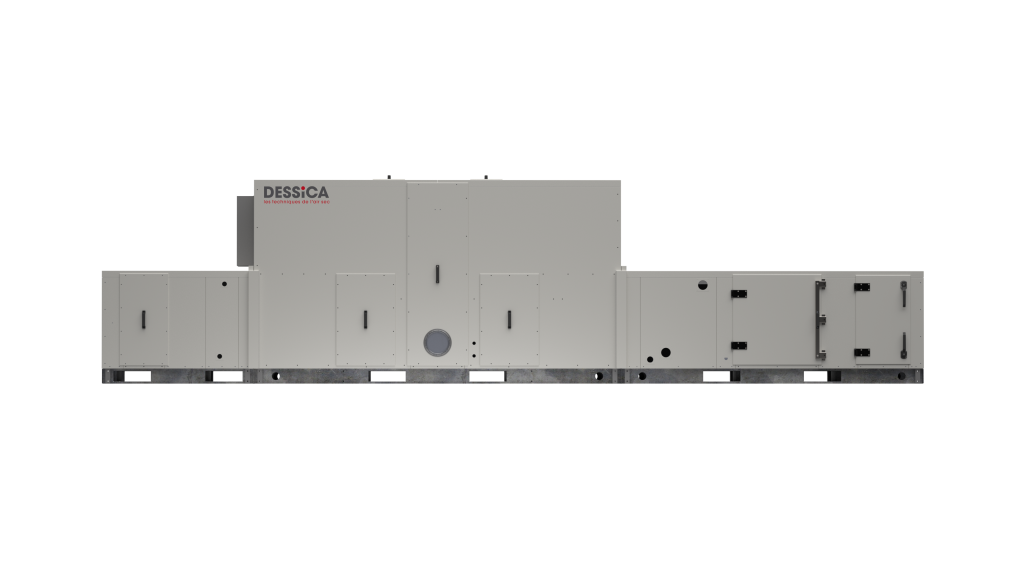
Heat recovery systems allow the treatment of a mixture of recirculated and fresh air to reduce energy consumption.
The dehumidification units were integrated into the comprehensive offer from Euroflux, the partner responsible for the design and construction of the clean rooms. This collaborative work enabled the delivery of a complete technical solution combining the air distribution network, clean room architecture, and air treatment.
How does a DESSICA industrial air-dryer work?
The air management systems operate continuously, 24h a day, with shutdowns on weekends and certain evenings. However, only part of the production is currently active: Advantelec has chosen to start with the downstream phase of the process, utilising around 40–50% of the plant’s total capacity.
Strict environmental management has also been implemented to preserve air quality: limitation of the number of people per room, door openings control, and regulation of interactions between operators.
DESSICA technicians are in charge of on-site commissioning to achieve the specified humidity levels. The equipment, which is highly sensitive, requires precise and fine adjustments to ensure stable conditions.
Maintenance of the air-dryer
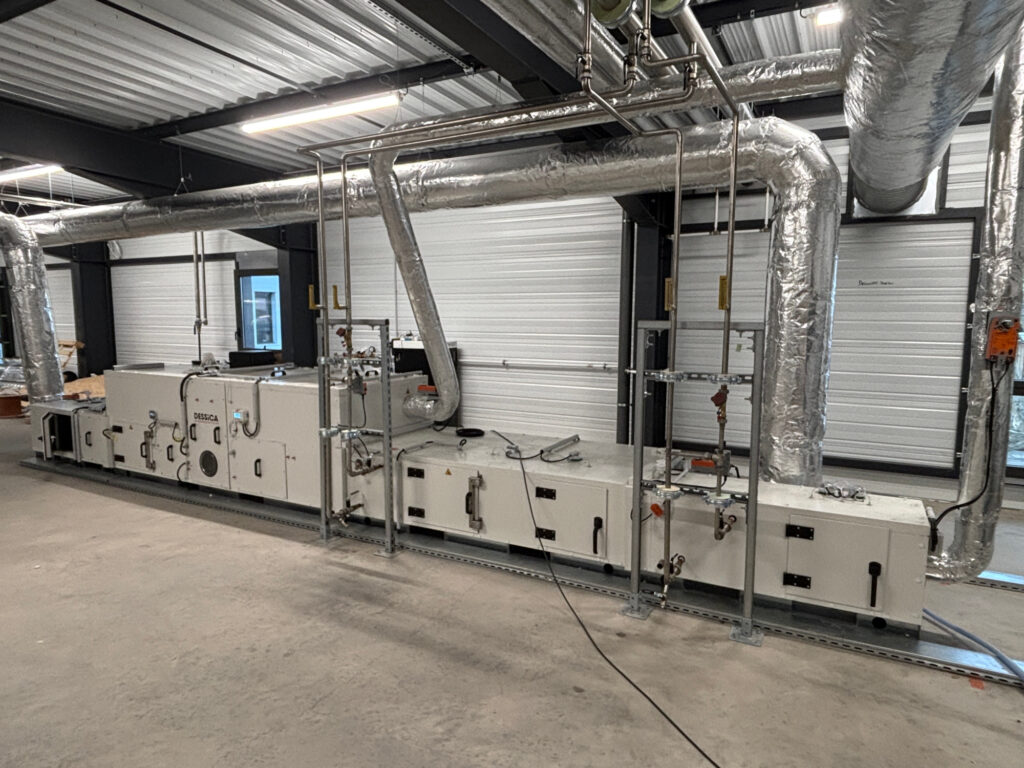
The dehumidification equipment supplied by DESSICA was installed in summer 2024. At this stage, no maintenance operations have been required, as the machines are still at the beginning of their operational cycle.
These systems are designed for long service life, provided regular maintenance is carried out. Periodic replacement of air filters and preventive maintenance of components ensure optimal performance and extend the equipment’s lifespan.
Benefits and Return On Investment (ROI)
The very low dew point air dehumidification system provided by DESSICA enabled Advantelec to meet the critical humidity control requirements for lithium battery manufacturing in an anhydrous clean room. This was achieved through the installation of two industrial air-dryers specifically designed for very low dew points (down to –50 °C).
Tangible benefits:
- Prevention of humidity related manufacturing defects (contaminant particles, performance issues)
- Preservation of thermal comfort for operators through an optimal temperature/humidity balance
- Durability of the installed equipment
- System flexibility, allowing adjustments as production lines evolve
- Close technical support from DESSICA, including advice, bespoke design, and maintenance
Through this investment, Advantelec secures its processes, anticipates future expansions, and strengthens its relocation strategy. Advantelec’s clean rooms are now fully operational and meet all defined requirements.
Read another customer case study: the CNRS in Amiens (a research laboratory for energy storage and conversion): How to maintain a dry atmosphere with a low dew point?


